
New Study: Wood-Based Black Pigments Work in Dope Dyeing
By Jane Palmer, CEO, Nature Coatings
BioBlack’s wood-based pigment has been successfully validated from pigment through finished fabric for performance and environmental impact in dope-dyed man-made cellulosic fiber (MMCF).
Dope dyeing is one of the most effective sustainability processes available to a textile supply chain.
Conventional dyeing methods color fabric after it’s made. Finished fabric goes into water baths with process chemistry, heat, and long cycle times, and what comes out the other end includes effluent that has to be treated, but dope dyeing does it differently. The colorant goes directly into a man-made polymer solution before the fiber is extruded, so color is locked inside at the moment it forms. No dye bath. No wash cycles. Dramatically less water and process chemistry, and color that cannot wash out because it was never sitting on the surface to begin with.
Dope dyeing has been commercially proven for decades; and for all that time the black going into the polymer solution has been petroleum carbon black. A brand could run the most water-efficient coloring process in textiles, but they were still putting a fossil fuel derivative into a wood-based fiber. Black is among the highest volume shades in apparel, so that makes a direct impact on Scope 3 accounting.
Beyond sustainability, the pigment has to disperse evenly through a viscous polymer solution, survive extrusion through a spinneret without clogging it, deliver commercial color depth at low loading, and then hold up through spinning, knitting or weaving, and everything a garment endures on the way to market. A pigment that performs beautifully in a print paste can fail completely in a spinning line.
So can bio-pigments work for dope dyeing? That is the question the Fashion for Good Black Pigment Project set out to settle. The project launched in 2022 with Birla Cellulose and Paradise Textiles as implementation partners and BESTSELLER, PVH Corp and the Kering Group supporting from the brand side. Lab trials were completed first and only formulations that cleared performance hurdles advanced to pilots.
BioBlack cleared, and the pilot succeeded.
BioBlack was dope-dyed into MMCF fibers that were assessed on color strength, tensile strength, and color fastness. After passing the performance tests, Paradise Textiles in Turkey spun it into a 40/01 single yarn and knitted it into a 95% viscose and 5% spandex single jersey at 150 GSM. Then the fabric went to additional performance testing, which is the part that decides whether any of the preceding work matters.
Colorfastness came back strong. Washing, water, perspiration, seawater and water spotting all rated 4 to 5 on the ISO scales. Dry crocking rated 4 to 5. Light fastness rated 4.0. Bursting strength measured 38, and dimensional stability on the warp was excellent at negative 0.4%. Pilling rated 2 to 3 after 2000 revolutions, which our testing partner assessed as commercially acceptable for viscose without any special spinning technique required. Their overall verdict was that the trial was successful with clear opportunities for refinement in subsequent rounds and no major concerns.
These were not just indicative laboratory results. They were ISO test outcomes on a finished knit fabric of a construction that garments are actually made from, produced on commercial equipment by named partners who can verify their portion of the supply chain. It’s the difference between a promising material and a specifiable one.
Additionally, the environmental case was measured rather than asserted. Fashion for Good commissioned a screening life cycle assessment benchmarking BioBlack against conventional carbon black, cradle to gate, per kilogram of colorant. BioBlack showed a 93% reduction in global warming potential, ecotoxicity fell by more than 99%, land use by 95%, acidification by 88%, and freshwater eutrophication by 74%. Those results are consistent with our own third-party assessment and were produced independently of it.
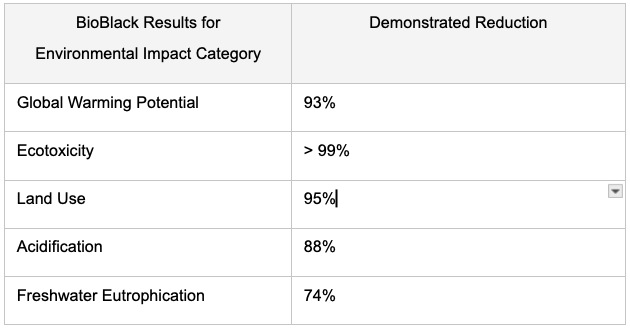
Indicative results from a preliminary screening LCA (not third-party verified).
So what does this study actually change?
For a brand, there’s a beautiful story and marketing opportunity about wood-based pigments dope-dyeing viscose with performance data and emissions data that will survive a technical review and a sustainability audit.
For a fiber producer or a mill, it means a bio-based black can be specified into an existing dope dyeing line without new capital equipment or a redesigned process, at loading levels the industry already uses. And for the wider argument about bio-based materials, it is one more instance of the same finding: the barrier was never whether these materials could work, it was whether anyone had put them through the full commercial gauntlet and published the results.
The work is not finished, and I would not want to suggest otherwise. Paradise Textiles has identified spinning refinements that would increase pilling performance further. But, overall, the pathway to commercial scale for dope dyed bio-based black is validated. If you are a brand, a fiber producer, or a mill evaluating black for MMCF, the performance data, the fabric test results, and samples are all available. Get in touch.